

The Red Filter is Withdrawn.
2020-08-02 · 12 min · Not rated
If you look into the entrance of one of the huge caves on the Korean island of Jeju, it looks like a camera lens. If you walk into the cave, it looks like a screen, a rectangle showing clouds and white light, just like a film. Director Kim Minjung delves into the bloody history of Jeju, where tens of thousands were killed in a massacre in 1948. The camera follows the traces in the landscape, sometimes transformed by a strident, distance-creating red light, accompanied by a commentary by avant-garde filmmaker Hollis Frampton. Film as a means to address history and its taboos.
Trailers are previews, not full movies.
No authorized playback source configured. Use the legal watch options below.
Production details
- Directors
- Kim Minjung
- Production companies
- Unavailable
- Countries
- South Korea
- Status
- Released
Top Cast
Cast unavailable.
Title information and images are supplied by TMDb. Explore our discovery guide for advice on comparing metadata and legal viewing options.
Where to watch
Availability provided by JustWatch via TMDb. Offers can change. Provider links are listed on TMDb; full playback requires a separately authorized source.
Availability not listed for this country.
Seasons & episodes
Recommendations
A real-life undercover thriller about two ordinary men who embark on an outrageously dangerous ten-year mission to penetrate the world's most secretive and brutal dictatorship: North Korea.
Amber Heard and Nicole Kidman discuss their characters Mera and Atlanna.

A string of threatening emails escalates into a revenge plot involving a newly married US marshal and his ex-girlfriend.

In an intimate and joyful story of love in the face of loss, celebrated poets Andrea Gibson and Megan Falley find strength—and unexpected hilarity—in what might be their final year together.
Featuring never-before-seen footage, this documentary delivers a startling new look at the Peoples Temple, headed by preacher Jim Jones who, in 1978, led more than 900 members to Guyana, where he orchestrated a mass suicide via tainted punch.
Join the likes of Jeremy Renner, Hailee Steinfeld, Florence Pugh, and Vincent D’Onofrio as they reveal how Marvel Studios’ “Hawkeye” was conceived and created. Witness firsthand what it took to pull off the show’s pulse-pounding action set pieces, and discover how iconic characters from the pages of Marvel Comics such as Kate Bishop were adapted and brought to life for the six-episode series.

In the Realms of the Unreal is a documentary about the reclusive Chicago-based artist Henry Darger. Henry Darger was so reclusive that when he died his neighbors were surprised to find a 15,145-page manuscript along with hundreds of paintings depicting The Story of the Vivian Girls, in What is Known as the Realms of the Unreal, of the Glodeco-Angelinnian War Storm, Cased by the Child Slave Rebellion.

Director Michael Apted revisits the same group of British-born adults after a 7 year wait. The subjects are interviewed as to the changes that have occurred in their lives during the last seven years.

Musician and performance artist Laurie Anderson reflects on the deaths of her husband Lou Reed, her mother and her beloved dog.
This raucous journey into the heart of democracy captures an unusual rite of passage: 1,100 teenage boys from across Texas coming together to build a representative government from the ground up.

A documentary on the expletive's origin, why it offends some people so deeply, and what can be gained from its use.

An inside look at one of the most anticipated movie sequels ever with James Cameron and cast.
The Captains is a feature-length documentary film written and directed by William Shatner. The film follows Shatner as he interviews the other actors who have portrayed starship captains in the Star Trek franchise.

A 1993 documentary film about Bruce Lee. The film includes interviews from some of his fellow students and opponents who worked alongside him in his movies.

A visual montage portrait of our contemporary world dominated by globalized technology and violence.

The film follows adventurer Jeff Johnson as he retraces the epic 1968 journey of his heroes Yvon Chouinard and Doug Tompkins to Patagonia.
Documentarian Ross McElwee originally set out to make a travelogue of sorts tracing General William T. Sherman's infamous scorched-earth march through the Confederacy in the latter stages of the Civil War. Instead, haunted by a recent breakup with a girlfriend, McElwee ends up documenting his progress -- or lack thereof -- in starting a new relationship. His journey then becomes one of self-reflection and self-discovery rather than a historical/sociological exploration.

A documentary about how a dominant cultural and demographic institution both sustains their traditional activities and adapts to the digital revolution.

Through deeply personal interviews with her siblings and an examination of the photographs, letters, and belongings left behind, Mariska assembles a new portrait of her mother Jayne Mansfield, an extraordinary and complex woman.

A compilation of over 30 years of private home movie footage shot by Lithuanian-American avant-garde director Jonas Mekas, assembled by Mekas "purely by chance", without concern for chronological order.
Similar titles

In an abandoned resort on the South Korean island of Jeju, a group of people perform a symbolic funeral ritual to end a world built on hierarchies, division and destruction.
Immediately after liberation, an incident called 'Jeju Uprising' took place on Jeju Island, the Hawaii of Korea, under the control of the US military government. As a result, about one-tenth of the total population of the island at that time was sacrificed. The children who survived the massacre record the memories of that day in an animated film 70 years later.
In the turmoil of the Jeju 4.3 incident, Jeju Island witnessed the loss of an estimated 25,000 to 30,000 lives, with women constituting a significant yet often unrecognized proportion of the victims. This documentary illuminates the once-shrouded experiences of these women, led by a dedicated Jeju 4.3 researcher.
Following water's flow through the volcanic body of Jeju Island, the film traces resilience across geological, historical, and mythical time. A lone visitor enters a cave where submerged memories—of militarization and exploitation—surface through sound.

Focusing on Mrs. Kang Sang-hee’s life, she lost her husband in the Jeju Uprising (March 3rd, 1948). The film views the dark-side of Jeju Island, a huge grave, which is completely opposite of the other side of the island, the famous tourist attraction. It says that the tragedy has been going on about the recent Gang-jeong village situation.
Confronting half of her mother’s life—her mother who had survived the Jeju April 3 Incident—the director tries to scoop out disappearing memories. A tale of family, which carries on from Dear Pyongyang, carving out the cruelty of history, and questioning the precarious existence of the nation-state.
The late Kim Dong-il, a Jeju April 3 refugee in Japan, left behind over 2,000 crocheted items and pieces of clothing that preserved her memories, identity, and history. As the film traces the redistribution of her belongings, it illuminates the still-unhealed lives of various Zainichi Koreans who lived through the same era, sharing and connecting their intertwined memories.
On the shores of Jeju Island, a fierce group of South Korean divers fight to save their vanishing culture from looming threats.

The film shows demonstrations against building the second airport in Jeju Island the performances of environmentalists very closely and in detail, by which it develops a desperate love story.
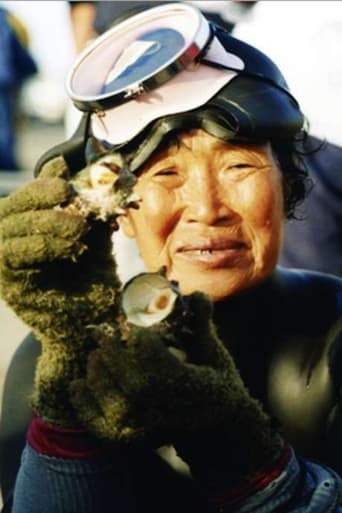
Jeju-do is the largest of Korean islands and lies between Korea and Japan. There, for hundreds of years, women dive without breathing apparatus, to the ocean floor and collect shellfish, octopus, and urchins that they sell. The divers are in their sixties and seventies and their daughters do not want to inherit their work, lifestyle, and health problems that go with diving. As a filmmaker I was privileged to meet many of these women and dive with them. Their stories of hardship and pride confirmed my desire to record this unique and ancient tradition.
This is a record of people who face up to the big change.

In the summer of 2021, film students shot a short film titled ‘In the Dry Stream’ on Jeju Island. This film reconstructs the filmmaking process from pre-production through production, utilizing outtakes from the short film, various production materials, and behind-the-scenes footage captured by the crew.
The oral writer of the April 3 Uprising and a Rwandan who came to Korea to study face each other, have a conversation, and then go on a trip hand in hand. The two people, from different generations, nationalities, and occupations, have something in common: they are the daughters of massacre survivors.
In 1948, a red wave rose. From Yeosu to Busan, the filmmaker traces lives and memories layered along the sea. The Yeosu-Suncheon Incident erupted when soldiers stationed in Yeosu refused orders to suppress the Jeju 4·3 uprising, and many civilians were killed during the Rhee Syngman government's crackdown. After the Korean War began, the government branded National Guidance Alliance members as communists and carried out massacres nationwide. Beyond the killing sites in both cities lies the sea, along which state violence flowed from Yeosu to Busan.
Documentary about the struggle of the people of Jeju Island, South Korea. Set in the context of the U.S. presence in Korea after World War II, the film reveals horrible atrocities at the hands of the U.S. Military Government of Korea.

Jeju authorities felled about 900 cedar trees on Bijarim-ro for a road expansion project. Citizens exposed the project's flawed environmental impact assessment, leading to its suspension. They continued efforts to protect Seongsan, slated for the second airport, and Bijarim-ro. This documentary follows the journeys of five women involved in this movement.

Battling deep depression, Jaeyoun returns to her roots on the island of Marano, South Korea, to visit her family of female free fivers known as haenyeo. To her surprise, she finds a connection to nature and her ancestors that literally saves her life.